How to Use Vibration Plates for Stronger Moves
That vibrating platform in the corner is not a shortcut button. Used with intention, it can make familiar movements feel more challenging, wake up stabilizing muscles, and add variety to your strength or recovery routine. Learning how to use vibration plates starts with one simple rule: let your position and control lead the workout, not the machine’s speed.
A vibration plate sends small, rapid vibrations through the platform. Your body responds by making tiny adjustments to stay stable. That is why a basic squat, plank, or calf raise can suddenly demand more focus. The goal is not to stand there and hope for results. The goal is to use the plate as a tool for strong, deliberate movement.
How to Use Vibration Plates With Good Form
Start by stepping onto the center of the platform with your feet about hip-width apart. Soften your knees right away. Locked knees send too much vibration up the legs and can make the experience uncomfortable. Think athletic stance: chest lifted, core gently braced, weight spread through your whole foot.
For your first few sessions, choose the lowest or a low-to-moderate setting and work for 30 to 60 seconds at a time. Step off, walk around, and notice how you feel before starting another round. Your muscles do not need an extreme setting to respond. In fact, lower settings often make it easier to hold solid alignment and learn what the vibration feels like.
Keep your eyes forward instead of looking down at your feet. Breathe normally. If your teeth are chattering, your joints hurt, or you feel dizzy, reduce the intensity or step off. A little muscle fatigue is one thing. Pain, numbness, or an unsteady feeling is your cue to stop.
Machine settings vary, so follow the instructions for the specific model in front of you. Frequency, amplitude, and programmed workouts are not always comparable from one plate to another. More speed is not automatically more effective. The best setting is the one that lets you stay in control.
Start With These Vibration Plate Exercises
The strongest place to begin is with movements you already know. Master a stable stance before adding dynamic exercises or longer intervals.
Athletic Hold
Stand with knees bent slightly, hips back, and your core engaged. Hold this position for 30 to 45 seconds. It looks simple, but your legs, glutes, and midsection will have to work to keep you steady. This is a great first move for getting comfortable with the sensation.
Bodyweight Squat
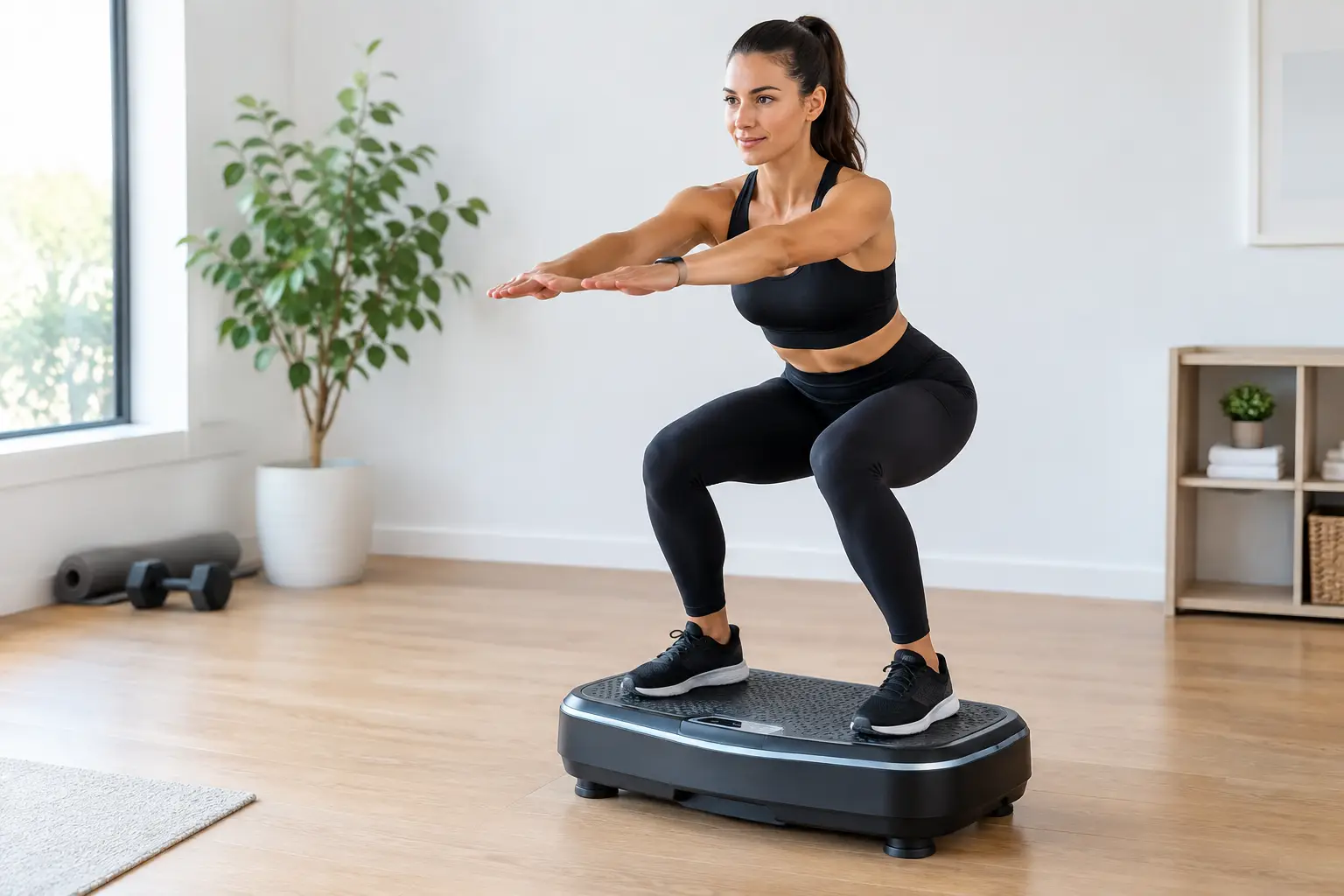
Set your feet firmly on the plate and lower into a squat as if you are sitting back into a chair. Keep your knees tracking in line with your toes, then press through your feet to stand tall. Move slowly for 8 to 12 controlled reps. Do not rush just because the platform is moving.
If you are new to squats, use a smaller range of motion. If you are more experienced, pause briefly at the bottom of each rep. That pause will tell you whether you are truly owning the position.
Calf Raises
Stand tall with a soft bend in your knees. Lift your heels, squeeze your calves at the top, then lower with control. Aim for 10 to 15 reps. Hold a nearby support lightly if balance is still a work in progress. The plate can make a calf raise feel surprisingly intense, especially when you slow down the lowering phase.
Glute Bridge With Feet on the Plate
Lie on your back in front of the machine with both feet planted on the platform and knees bent. Drive through your heels, lift your hips, and squeeze your glutes without arching your lower back. Hold for 20 to 30 seconds or complete 10 slow reps.
This setup can be a smart option when you want to train your glutes and hamstrings without loading a barbell. Keep your hips level. If the vibration makes it difficult to stay stable, lower the setting or return to a floor bridge.
Incline Plank
Place your hands on the plate, step your feet back, and create one long line from head to heels. Keep your shoulders stacked over your hands and pull your ribs gently toward your hips. Start with 15 to 30 seconds.
An incline plank is usually more approachable than putting your feet on the plate. Once your core control is solid, you can progress to a high plank with your feet on the platform. Do not let your low back sag just to hold the position longer.
Recovery Stance
After a tough workout, some people enjoy standing on a low setting with knees soft for a short cooldown. Others prefer a gentle calf or hamstring stretch with one foot on the plate while the machine is off. Recovery is personal. If vibration leaves you feeling more tense rather than refreshed, skip it and choose walking, mobility work, or restorative yoga instead.
Build a Short, Effective Routine
You do not need a 30-minute vibration plate session to make it worthwhile. Two or three short blocks can fit before strength training, after cardio, or on a day when you want focused movement without a huge time commitment.
Try this beginner-friendly sequence: 45 seconds in an athletic hold, 10 bodyweight squats, 12 calf raises, 20 seconds of glute bridge, and 20 seconds of incline plank. Rest for 30 to 60 seconds between exercises. Repeat the circuit two or three times at a setting that feels challenging but manageable.
As you gain confidence, progress one variable at a time. You might add five seconds to a hold, two reps to an exercise, another round, or a slightly higher setting. Do not increase everything at once. Better form at a modest intensity beats shaky form at maximum intensity every time.
For a strength-focused day, use the plate as a warm-up or finisher, then do your regular resistance work. For a mobility-focused day, keep the setting low and pair short holds with controlled stretches. For a full-body fitness class, it can become one station in a bigger workout that includes yoga, cardio, and strength. That variety keeps training fun while giving your body different challenges.
What Vibration Plates Can and Cannot Do
Vibration plates can add an extra balance and stability challenge to bodyweight exercises. They may also help you feel more engaged in movements that have become routine. But they are not a replacement for progressive strength training, daily movement, nourishing food, sleep, or consistency.
If your goal is muscle strength, you still need resistance that gradually challenges you over time. If your goal is fat loss, your overall activity, nutrition habits, and recovery matter far more than a few minutes on a platform. The plate can support your plan, but it cannot carry the whole plan for you.
That is actually good news. There is no need to chase a magic machine. Build the habits that make you feel powerful, then use tools like vibration training to keep your routine fresh and your body challenged.
Safety Comes Before the Setting
Vibration training is not right for every body or every season of life. Talk with your doctor or qualified healthcare professional before using a vibration plate if you are pregnant; have a pacemaker or other implanted medical device; have a history of blood clots; have significant heart, bone, joint, nerve, or circulation concerns; recently had surgery; or are managing an acute injury. The same goes for unexplained pain, frequent dizziness, or new symptoms that have not been evaluated.
For everyone else, give yourself permission to start small. Wear supportive shoes if you feel more stable in them, keep water nearby, and make sure the platform is on a level surface. Never use the plate when it is wet or try to jump on and off while it is running. Controlled movement is the Warrior move.
At Warrior 1 Yoga, vibration training can be part of a bigger, more exciting routine – one that includes strength, mobility, sweat, and a room full of people who are showing up for themselves. Your first session does not need to look impressive. Step on, soften your knees, own your form, and let every steady rep remind you that strong is built one choice at a time.