
Barre vs Pilates Strength: Which Builds More?
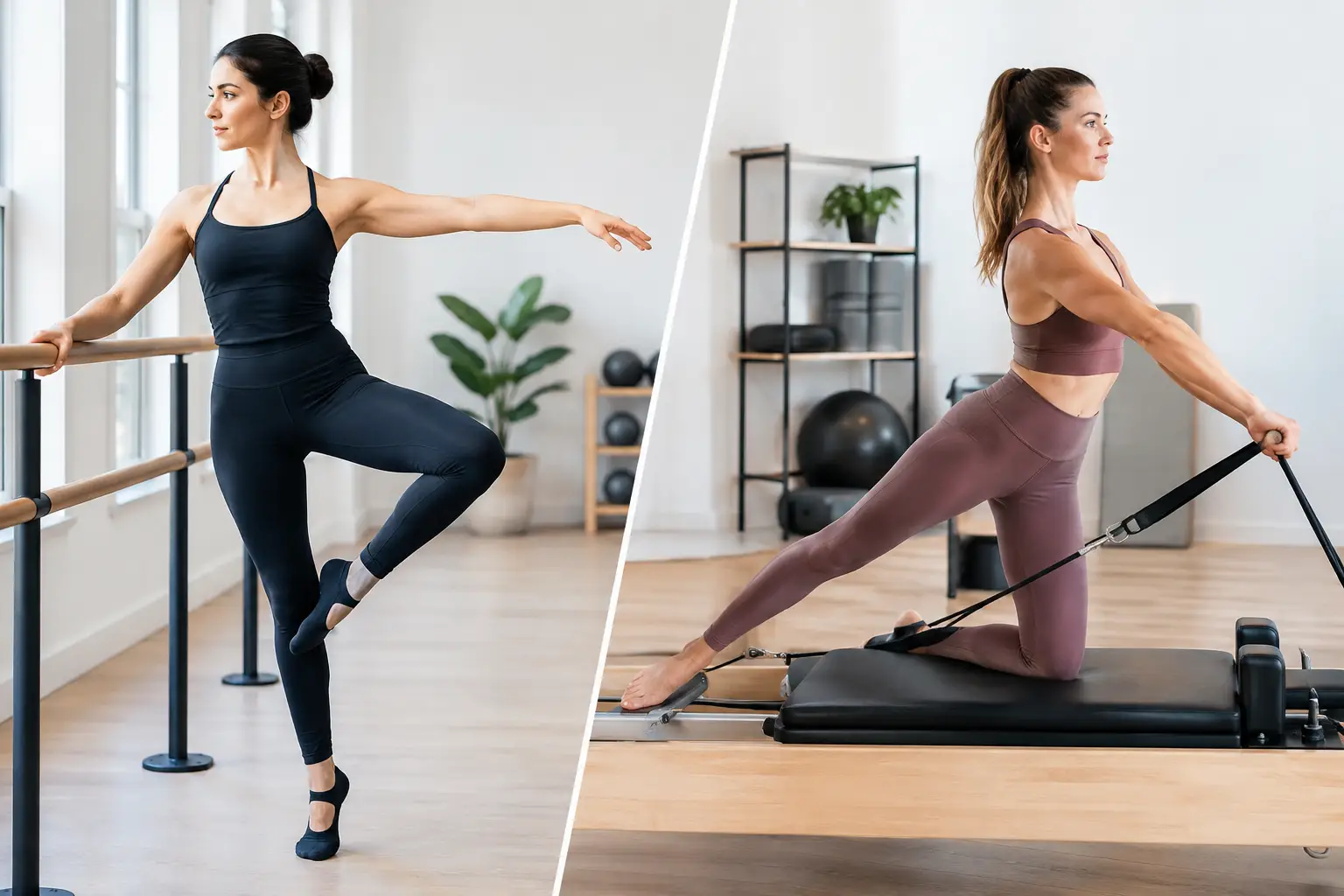
That thigh shake in barre is real. So is the deep-core burn you feel in Pilates when a slow, precise movement suddenly makes your whole body work. When it comes to barre vs pilates strength, neither workout is “easy” – but they build strength in different ways. The better choice depends on what you mean by strong, what your body needs, and what kind of class keeps you coming back ready to sweat.
Barre vs Pilates Strength: The Big Difference
Barre training is built around high repetitions, small controlled movements, isometric holds, and a serious lower-body burn. Think squat pulses, calf raises, standing leg work, planks, and light weights. Your muscles spend a lot of time under tension, often while holding a position that looks simple until your legs start shaking.
Pilates focuses more on controlled movement, alignment, breath, and core-driven strength. Traditional Pilates may be done on a mat or with equipment such as a reformer. The goal is not to race through reps. It is to create intentional movement from a stable center while building control through the hips, glutes, back, shoulders, and abs.
Both can improve muscular endurance, balance, posture, and body awareness. Barre typically feels more immediately athletic and leg-focused, while Pilates often feels more technical and core-focused. Neither replaces every kind of strength training, especially if your goal is to lift increasingly heavy loads. But both can make you a more capable mover in the studio and in real life.
Does Barre Build Strength?
Yes – especially muscular endurance. Barre asks muscles to keep working for extended periods with little rest. A sequence of wide squats, pulses, holds, and heel lifts can challenge your quads, glutes, hamstrings, and calves without ever picking up a heavy barbell.
That repeated tension matters. Over time, barre can help your legs and glutes feel stronger during stairs, hikes, yoga poses, and cardio workouts. Core work, planks, and light dumbbell sections can also build shoulder and upper-body endurance.
The trade-off is resistance. Most barre classes use body weight, bands, a ball, and lighter weights. Those tools are plenty challenging when the tempo is slow and the reps stack up, particularly for beginners or anyone returning to movement. But if your main goal is maximum muscle growth or dramatic increases in raw strength, you need progressive overload – gradually increasing the load, resistance, or challenge over time.
A barre class can be part of that plan, but it may not be the whole plan. It shines when you want strength with balance, mobility, posture, and a high-energy sweat factor.
Where Barre Hits Hardest
Barre is especially effective for lower-body endurance and stability. The constant work through the hips, thighs, calves, and glutes can build control that carries into lunges, squats, yoga balance poses, and even running.
It also asks your core to stay switched on while your arms or legs move. You may not be doing endless crunches, but your midsection has to stabilize your pelvis and spine. That is functional strength – the kind that helps you move with more control instead of simply moving more weight.
Does Pilates Build Strength?
Pilates absolutely builds strength, but it is often less about chasing fatigue and more about creating a strong foundation. You learn to brace and move with intention, instead of letting momentum take over. A well-taught Pilates session challenges the deep abdominal muscles, pelvic floor, glutes, spinal stabilizers, and shoulder muscles that support good movement.
This can be a game-changer if you sit at a desk, deal with recurring tightness, struggle to feel your core during workouts, or want more control in yoga and strength classes. Pilates teaches you to notice whether your ribs flare, your hips shift, or your shoulders creep up toward your ears. That awareness can make every other workout better.
Mat Pilates can be surprisingly tough because body weight becomes resistance when movements are slow, long-levered, and precise. Reformer Pilates can offer more opportunity to progress strength because springs provide adjustable resistance. Still, Pilates is not automatically a heavy strength workout. The class format, instructor, equipment, and your effort all matter.
Where Pilates Has an Edge
Pilates often has the edge for deep core control, alignment, and movement quality. It can help you build the stability needed to squat with better form, hold a stronger plank, move more confidently through a yoga flow, and feel less wobbly on one leg.
That does not mean Pilates is only for recovery days. Advanced variations can light up your abs, glutes, inner thighs, and upper body fast. The difference is the sensation. Barre may make your muscles shake from high-volume holds. Pilates may challenge you because every inch of a movement demands focus.
Which Is Better for Building Muscle?
If “building muscle” means visibly increasing muscle size and your ability to handle heavier resistance, neither barre nor mat Pilates is usually the fastest standalone route. Traditional strength training with progressively heavier dumbbells, kettlebells, cables, or barbells is more direct for that goal.
But that does not make barre or Pilates less valuable. Both can support muscle development when they are challenging enough, practiced consistently, and paired with recovery and adequate protein. Barre may feel closer to a strength-endurance workout, particularly in classes that include weights and longer lower-body segments. Reformer Pilates can provide a meaningful strength challenge when spring resistance is progressively increased.
For many people, the smartest answer is not barre or Pilates. It is barre or Pilates plus a strength-focused class. You get the burn, core work, mobility, and accountability of boutique group fitness while also giving your muscles enough resistance to grow stronger over time.
Choose Barre If You Want Energy, Heat, and the Burn
Barre may be your move if you love music, fast-moving class energy, and the feeling of working hard from the first few minutes. It is a great fit for someone who wants toned-feeling legs, stronger glutes, better balance, and a workout that feels athletic without being high impact.
It can also be more approachable than a weight room. You do not need to know how to load a barbell or design your own program. Show up, follow the coaching, and let the small movements humble you. Beginners can modify range of motion, take breaks, and build stamina class by class.
At Warrior 1 Yoga, barre-inspired movement can fit beautifully into a weekly routine with heated yoga, yoga sculpt, cardio, and strength-based classes. Variety keeps training fun, and fun makes consistency much easier.
Choose Pilates If You Want Control and a Stronger Foundation
Pilates may be the better fit if you want to understand your body better. It is ideal for people who want to strengthen their core without relying on high-impact moves, improve posture, or build confidence after time away from exercise.
It can also complement intense workouts. If you love HIIT, kickboxing, running, or heated power yoga, Pilates gives you a chance to work with precision rather than always pushing speed. That can help you notice weak links before they become the places where your form falls apart.
Do not mistake control for low effort. Pilates works best when you stay present, move slowly enough to own the exercise, and choose progressions that challenge you without sacrificing form.
A Stronger Weekly Routine Uses Both Intensity and Control
Your body does not need the same workout every day. A balanced week might include barre for lower-body endurance and energy, Pilates-style core work for stability, yoga for mobility and recovery, and dedicated resistance training for progressive strength.
If you are newer to fitness, start with two or three classes per week and pay attention to how you recover. If you already train regularly, use barre and Pilates to fill the gaps around your heavier strength sessions. The best plan is the one that challenges you, fits your schedule, and makes you feel excited to walk back into the studio.
Strength is not just the amount of weight you can lift. It is the ability to hold steady, move well, recover with confidence, and keep showing up. Pick the class that makes you feel like a Warrior, then give it enough consistency to let that strength show up everywhere else.