
Does Restorative Yoga Help Sleep Better?
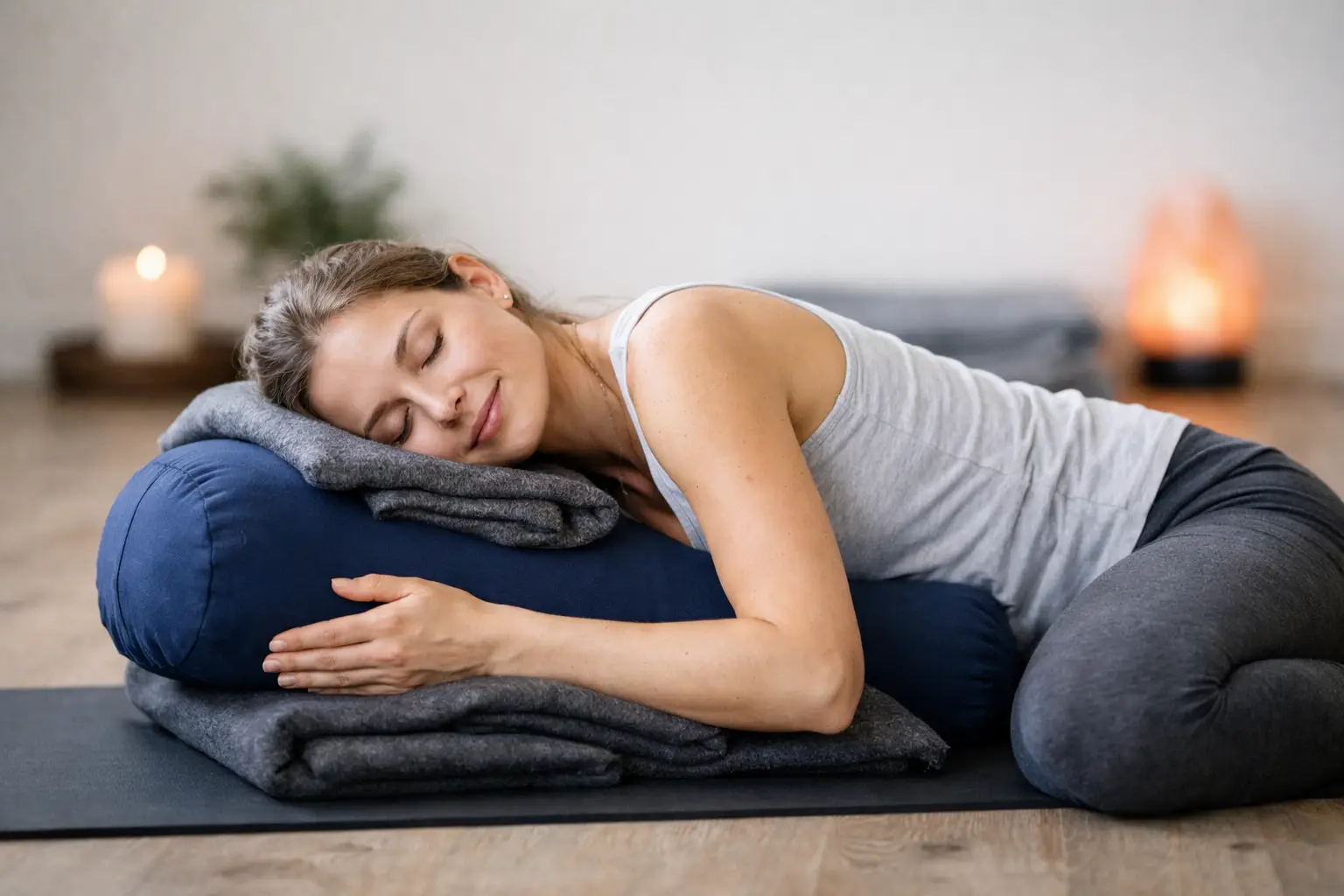
You finish a long day tired but somehow still wired. Your shoulders are parked near your ears, your brain is replaying tomorrow’s to-do list, and scrolling in bed is not making you sleepy. So, does restorative yoga help sleep? For many people, it can be a powerful way to shift out of go-mode and into a calmer state that makes sleep feel more possible.
Restorative yoga is not about working harder, sweating more, or pushing for a deeper stretch. It is about using props, longer holds, and very little effort to give your body a chance to downshift. Think blankets, bolsters, blocks, slow breathing, and positions you can actually relax into. That matters when stress, muscle tension, or a packed schedule is keeping you alert after the day should be over.
How restorative yoga can support better sleep
Sleep is not a switch you can force. Your body needs signals that the pressure is off. Restorative yoga can provide those signals by encouraging slower breathing, reduced physical tension, and stillness without the pressure to “perform” your practice.
When you stay in a supported pose for several minutes, your nervous system has an opportunity to move away from the fight-or-flight energy that can show up as racing thoughts, a tight jaw, or restless legs. You are not trying to empty your mind. You are simply giving your mind fewer things to manage while your body gets comfortable.
The physical piece counts, too. Sitting at a desk, carrying kids, training hard, commuting, and everyday stress can leave the hips, back, neck, and chest feeling wound up. Gentle, supported positions may ease that end-of-day stiffness. A body that feels safer and more comfortable is often less likely to demand your attention when you get into bed.
There is also the routine effect. Repeating the same short wind-down ritual teaches your brain what comes next. If you dim the lights, put your phone away, and spend 10 minutes in restorative shapes most nights, the practice can become a cue for bedtime. The poses are helpful, but the consistency is part of the magic.
Does restorative yoga help sleep for everyone?
It depends on what is disrupting your sleep. Restorative yoga may be especially useful when stress, anxious energy, soreness, irregular routines, or trouble settling down are major factors. It can be a practical tool for the busy professional whose workday follows them home, the parent who finally gets a quiet moment at night, or the hard-charging fitness fan who needs recovery as much as another workout.
It is not a guaranteed fix for chronic insomnia, sleep apnea, severe depression, ongoing pain, medication side effects, or other medical concerns. If you regularly struggle to fall asleep, wake up gasping, experience intense daytime fatigue, or have sleep problems that last for weeks, talk with a qualified health professional. Yoga can support healthy habits, but it should not replace care when something bigger is going on.
The timing also matters. A high-energy heated flow, cardio workout, kickboxing class, or heavy strength session can feel amazing, but doing intense exercise too close to bed may leave some people energized. Others sleep great after it. Learn your own pattern. If evening workouts make you feel switched on, save your heat, music, and sweat session for earlier in the day, then use restorative yoga as your cooldown into the night.
What a sleep-friendly restorative practice looks like
Your bedtime practice does not need to be an hour long or look perfect. Ten to 20 quiet minutes is enough to create a real pause between the day and bed. Keep the room comfortably cool, lower the lights, and choose loose clothing that does not distract you. You do not need fancy equipment. Pillows, a folded blanket, and a couch cushion can work well.
Start with a supported child’s pose. Kneel with a pillow or bolster lengthwise in front of you, then fold forward and turn your head to one side. Let your belly and chest rest on the support rather than holding yourself up. Stay for two to four minutes, switching the direction of your head halfway through if that feels good.
Next, try a reclined bound angle pose. Lie on your back, bring the soles of your feet together, and let your knees open gently. Place pillows under each outer thigh so there is no strain in the hips. One hand on your chest and one on your belly can help you notice your breath without trying to control it. If this position bothers your low back or hips, skip it. Comfort wins.
A legs-up-the-wall variation is another strong option, especially after a day spent standing, walking, or training. Lie near a wall and rest your legs up it, with your arms relaxed by your sides. If getting to the wall feels like too much hassle, place your calves on the seat of a chair while lying on the floor or bed. Stay there for three to five minutes and let the effort leave your legs.
Finish with a supported rest. Lie on your back with a pillow under your knees and a folded blanket under your head. Cover up if you tend to get chilly. Give yourself five minutes with no agenda except staying present. If thoughts show up, that is normal. Try a simple phrase on each exhale: “Not tonight,” “I can rest,” or “Tomorrow can wait.”
Breathe slower, but do not force it
The breath is one of the quickest ways to change the feel of a restorative practice. Keep it easy. There is no prize for taking the biggest breath in the room.
Try breathing in naturally, then allowing the exhale to be a little longer. For example, inhale for a comfortable count of three or four, then exhale for four or five. If counting makes you tense, drop the numbers. The goal is softness, not control.
Avoid forceful breathwork near bedtime. Fast, intense, or stimulating breathing techniques can make some people feel more awake or lightheaded. A sleep practice should leave you feeling grounded, heavy in the best way, and ready to climb under the covers.
Common mistakes that make a calming practice less calming
The biggest mistake is turning restorative yoga into another task to win. If you are checking the clock, trying to stretch farther, or judging yourself for not relaxing quickly, ease up. Rest is still productive, even when your mind is busy.
Another common issue is using poses that are not actually supported enough. If your neck is craning, your low back is pinching, or your hips are working to stay open, add more pillows or choose a different position. Restorative yoga should feel sustainable. A mild stretch is fine, but pain, numbness, or strain means it is time to adjust.
Finally, protect the space around the practice. A restorative pose followed immediately by bright lights, work emails, and 20 minutes of social media sends mixed signals. Keep your post-yoga transition simple: brush your teeth, set out what you need for morning, and head to bed.
Build a routine you will actually repeat
The best sleep routine is not the most elaborate one. It is the one you can do on a Tuesday when you are exhausted. Start with two poses and 10 minutes, three or four nights a week. Once that feels natural, add time only if you want it.
If you love a full studio experience, a restorative class can also teach you how it feels to truly use props and release effort. At Warrior 1 Yoga, restorative work offers a valuable counterbalance to the heat, strength, cardio, and high-energy movement that make training feel so good. Your Warrior side can sweat hard, and it can recover on purpose.
Give the practice a fair trial for two weeks. Notice more than just whether you fall asleep faster. Pay attention to your mood at bedtime, how often you wake up gripping tension in your body, and whether your evenings feel less frantic. Better sleep sometimes begins with a small decision: stop asking your body to do one more thing, and give it a few quiet minutes to rest.